April 27, 2026
From Static to Smart: How SmartCapture Helped Deliver 10x the Flood Protection at a Fraction of the Cost
Background
The Lake Sal watershed in Statesboro, Georgia covers roughly 600 acres of mixed land use, including homes, commercial areas, and key transportation corridors. For years, the region faced persistent drainage challenges that strained its aging stormwater infrastructure.
Since the basin funnels runoff into a limited conveyance system, even moderate storms frequently pushed water levels beyond the capacity of existing outfalls, overwhelming nearby roads and neighborhoods.
Challenge
During large storm events, water regularly overtopped Zetterower Road and Northlake Drive, creating hazardous driving conditions and isolating residents. Homeowners near the Lake Sal spillway and downstream along Northlake Drive and Needle Lane experienced repeated flooding in yards and, in some instances, inside homes.
The underlying infrastructure was undersized for growing hydrologic demands, yet early evaluations showed that a traditional structural fix such as constructing a regional detention facility upstream would be cost‑prohibitive for the City of Statesboro.
With limited available land, environmental constraints, and a clear need for more storage capacity than the existing lake footprint could offer, the City needed an alternative approach that could deliver meaningful flood mitigation without the cost and disruption of major new construction.
Solution
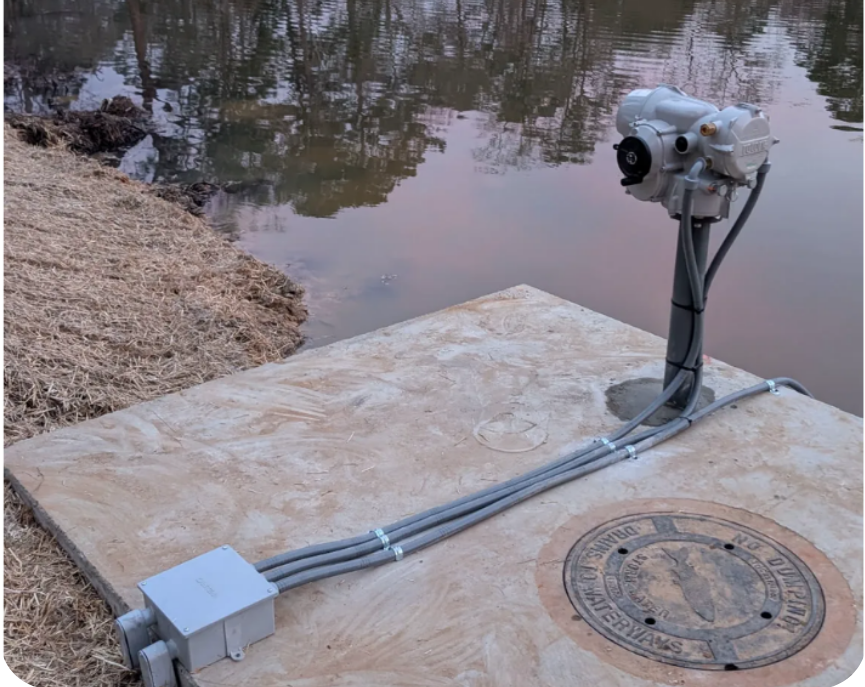
To achieve a more scalable and financially viable outcome, the City adopted a technology‑enabled stormwater strategy centered on Oldcastle Infrastructure’s SmartCapture™ system, powered by Opti. SmartCapture uses Continuous Monitoring and Adaptive Control (CMAC) to adapt in real time to real-world conditions, adjusting storage within the system to proactively manage stormwater. Oldcastle Infrastructure played a pivotal role by providing the smart-enabled outlet control structure that made this transformation possible.
Working closely with Opti and the project engineer, GMC, Oldcastle Infrastructure integrated the actuated valve assembly directly into a purpose‑built structure before it ever arrived on-site. This allowed the system to be installed quickly and seamlessly, minimizing disruption to the existing lake and surrounding community.
With the new structure in place, Lake Sal transitioned from a static retention system to an actively managed, cloud‑connected asset. SmartCapture continuously monitors NOAA weather forecasts, lake levels, and downstream conditions. When a major storm is predicted, the system automatically initiates a controlled drawdown, typically lowering the lake by about two feet, to create approximately 19.5 acre‑feet of additional storage within the existing footprint. Throughout a storm, the system adjusts releases in real time, optimizing storage capacity and reducing downstream peak flows.
Oldcastle Infrastructure’s smart-enabled outlet structure served as the physical foundation for this adaptive control approach, ensuring that all mechanical and digital components operated as a single, integrated system.
Impact
The shift to digitally managed stormwater provided protection that would not have been economically achievable through conventional construction alone. By combining civil engineering design, cloud-based analytics, and Oldcastle Infrastructure’s purpose-built smart structure, the project delivered a dramatic increase in storage capacity at a significantly lower cost.
The adaptive system cost roughly 60% less than a comparable regional detention project while delivering over ten times the effective storage capacity: 19.5 acre‑feet compared to an estimated 1.5 acre‑feet achievable through traditional alternatives. Since the project reused the existing lake and required only modifications to the outlet structure, it avoided land acquisition, minimized permitting impacts, and eliminated disturbance to wetlands.
The community also benefited from a balanced approach to lake management. Drawdowns occur only when an incoming storm requires additional storage, allowing Lake Sal to maintain normal water levels for recreation and wildlife habitat throughout most of the year. With lower peak discharge rates and expanded available storage, the system reduces flooding risk for downstream neighborhoods and improves resilience for the broader drainage network.
Conclusion
Through the collaboration of project partners, led by Oldcastle Infrastructure’s delivery of the smart-enabled outlet control structure and supported by Opti’s adaptive technology, the City of Statesboro successfully transformed Lake Sal into a responsive, high‑performing stormwater asset.
What once required costly structural expansion was replaced with a more efficient, sustainable, and affordable solution. The result is a resilient system that protects residents, preserves natural resources, and sets a precedent for modern stormwater management.
Learn more:
- Discover SmartCapture
- Request a SmartCapture lunch and learn
- Read about how smart infrastructure helps in an unpredictable climate