August 21, 2026
Non-Revenue Water: Why Utilities Need to Choose Their Own Adventure

Non-revenue water is not a new issue, but utilities still struggle to detect, locate and fix the leaks in their water distribution networks. Jamie Bourassa argues that fitting the right technology to the right customer is the biggest impediment to truly solving this challenge.
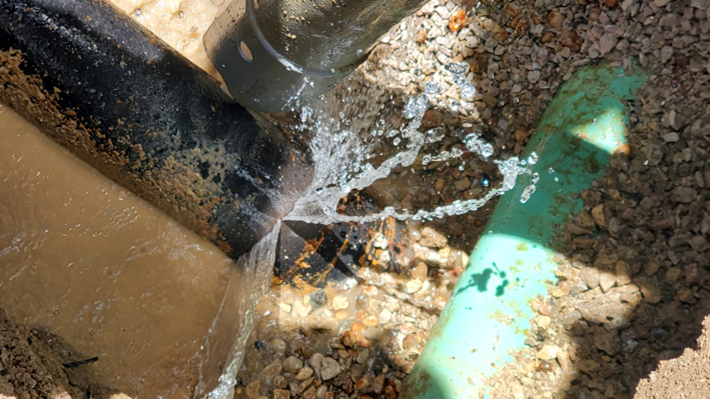
Every year, U.S. drinking water utilities lose about 19.5% of the water they abstract, treat and pump before it ever reaches a paying customer. That’s over 6,800 million gallons a day, walking out of pipes as leaks, hiding in bad meter data, or disappearing into unauthorized use. In total, this costs water utilities $6.4 billion a year.
Non-revenue water (NRW) isn’t a new problem; it’s one of the oldest problems in the water industry. What’s new is the amount of technology now available to fight it: acoustic sensors, satellite leak detection, predictive assessments, AI-driven correlation, digital twins, advanced metering infrastructure. On paper, we’ve never had more tools to close the gap.
So why is NRW still an issue that utilities are grappling with?
I’ve spent the better part of my career on this exact question, just from a different angle. At APC and then Schneider Electric, I lived the transformation cloud computing forced on critical infrastructure — watching edge technology get pressure-tested in medical imaging, robotic warehouse management, and point-of-sale transformation (yes, those dreaded self-checkout lines).
Every one of those started as “cool tech” and only earned its place once it proved out as a high-ROI asset — self checkout didn’t stick because it was novel, it stuck because it cut labor cost and lifted throughput enough to pay for itself.
I wrote about this pattern at the time: the operators who succeeded weren’t the ones who ripped out their existing operations for a full-stack overhaul, they were the ones who let a new technology prove itself on one well-defined problem before scaling it further.
What I learned in that period applies almost word for word to what I’m seeing in water today: the technology usually isn’t the bottleneck. Fit is.
The gap isn’t ambition. It’s fit.
We worked in partnership with Bluefield Research to conduct an industry survey of 100 water and wastewater utilities to put real numbers behind something most of us already sense: utilities have crossed into the “aware and interested” phase of digitization, but not the “widely adopted” phase. That’s the chasm.
The demand side of this is not in question. Seventy-two percent of drinking water respondents told us the benefits of reducing non-revenue water outweigh the costs of addressing it. And when we asked what’s actually driving that investment, “cost of lost water” and “utility leadership priorities” tied as the top factors, with 88% and 86% of respondents respectively rating them as significant or extremely significant.
Utilities are convinced of the value. This isn’t a persuasion problem. It’s an adoption-model problem.
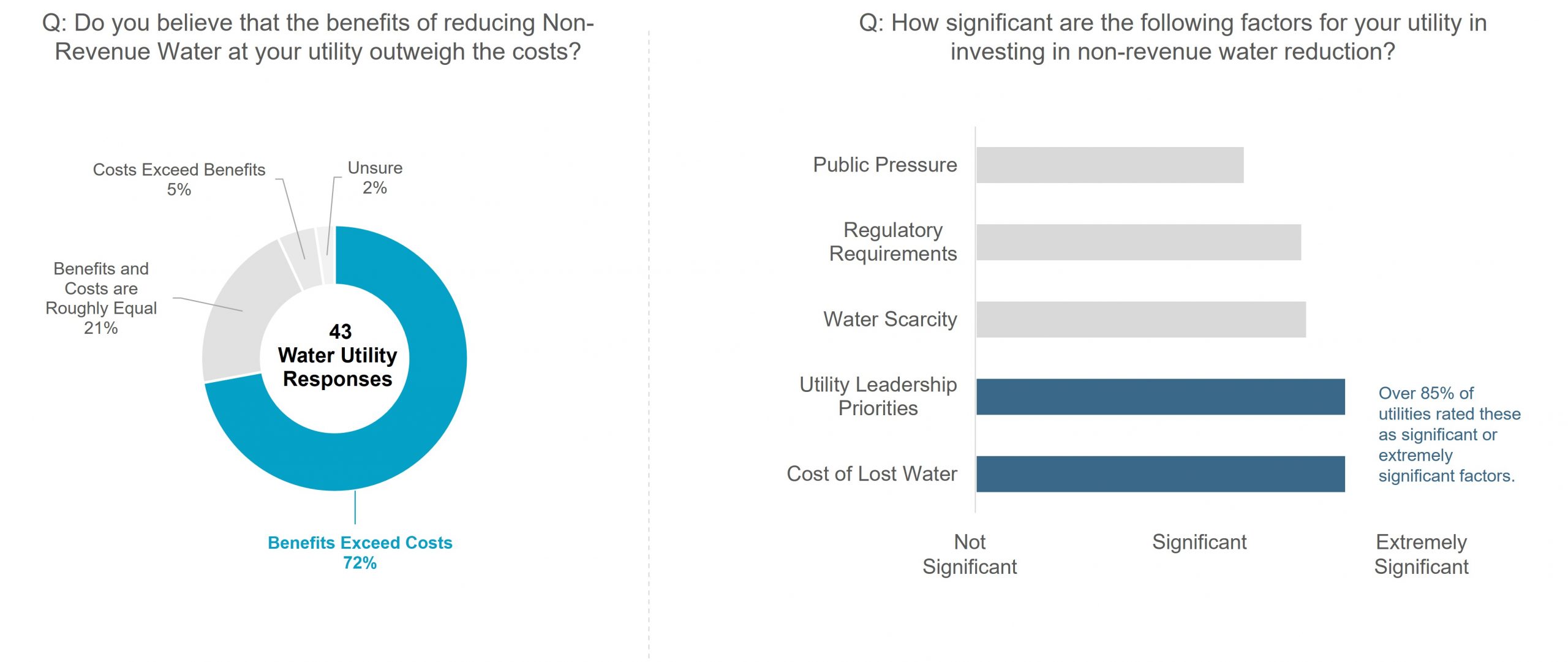
Image source: Bluefield Research & Oldcastle Infrastructure online survey of 100 water and wastewater utilities, conducted July 2026
Here’s where I keep seeing the gap: it’s rarely that a utility deployed the wrong technology. It’s that the utility went in without a clear expectation of what they were actually trying to accomplish, misaligned with a real understanding of what the technology can do — and, more importantly, what it can’t. A technology gets scoped to solve everything, when the utility actually needed it to solve one specific, well-defined problem this budget cycle. The mismatch isn’t in the sensor or the algorithm. It’s in the conversation that happened, or didn’t happen, before the contract was signed.
The data backs this up. Publicly owned utilities report meaningfully higher water loss than their private counterparts — 20.6% versus 17.8% — and the gap tracks closely with staffing and technical resources, not ambition or awareness.* That’s not a technology gap. It’s a scale-and-support gap, and it’s exactly where a one-size-fits-all product strategy breaks down.
What utilities are actually asking for
One of the clearest signals in the research: utilities may benefit from flexibility — the ability to adjust scope as data starts coming in and real problems reveal themselves. Traditional, rigid engineering-style contracts may limit how useful digital tools can actually be. Procurement cycles are shortening too, with many utilities favoring one- to two-year timelines and annual subscriptions precisely so they aren’t locked into last year’s technology.
The survey found utilities rarely want purely temporary or permanent installations. In other words: let me leverage my budget flexibly, depending on my needs.
We see this first hand. Our business operates across every utility type — small and large, well-financed and constrained, coast to coast. This gives us a unique understanding of the diversity of utility needs and realities.
This is the inflection point that matters, and in my experience it splits into roughly four paths:
- There’s the utility that just needs to check the compliance box — narrow scope, minimal lift, done.
- There’s the utility trying to find where its actual water loss is happening — a diagnostic problem before it’s ever a technology problem.
- There’s the utility building a sustainability culture, where NRW reduction is part of a broader conservation and stewardship mandate that has to show up in how the organization operates, not just in a dashboard.
- And there’s the utility doing longer-range assessment for capital planning, using NRW data as one input into where the next decade of infrastructure investment should go.
Four different starting points, four different definitions of success. Selling all four the same product, the same way, misses at least three of them.
Picking your adventure
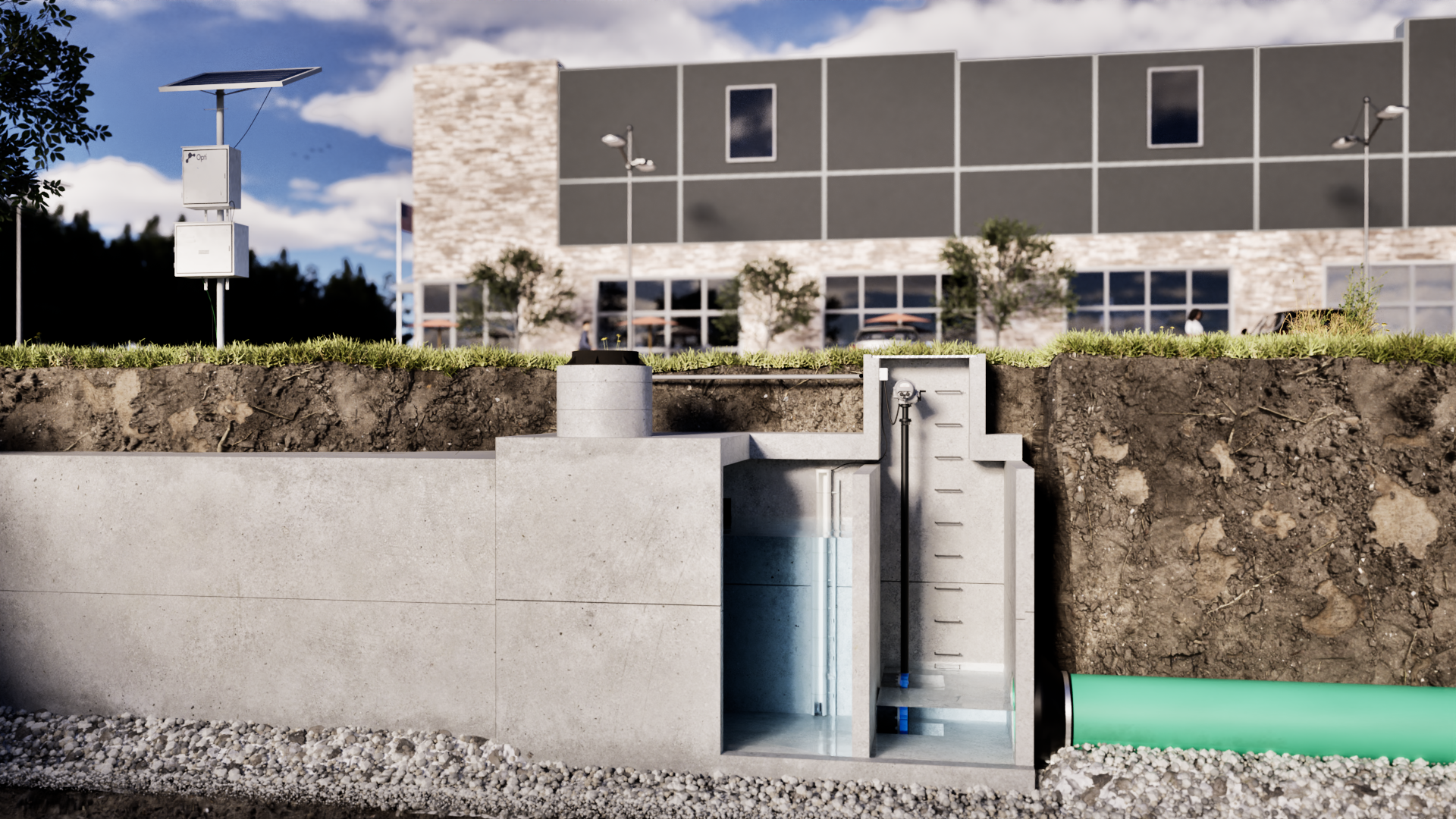
This is where I think about the CivilSense™ Non-Revenue Water module specifically — built on a predictive AI model that references a library of over 2.3 million acoustic signatures, layered with GIS data, for real-time leak detection. It’s built to target both real losses and apparent losses, because a utility rarely has just one or the other. What makes it relevant to this conversation isn’t a single feature; it’s the range of ways a utility can enter.
A staff-constrained utility that just needs to know where the worst leaks are this year can access Leak Detection as a Service — outcome-based, temporary deployment, no new headcount to manage a platform. A utility further along its digital journey, with GIS and SCADA already in place, can move to a self-service model that layers AI-based prediction and correlation on top of data it already owns. And a utility ready to commit — one that has proven the ROI through a pilot — can move to permanent sensor infrastructure and an owned or hybrid-leased deployment.
Business models across the industry are still sorting themselves out between owned infrastructure, “as-a-service” leakage detection, and hybrid leasing — and that’s a feature of a maturing market, not a flaw. The point isn’t that every utility should land in the same place. It’s that the module should be able to meet whichever of the four paths above a utility is actually on.
The real lesson from other industries
Every industry that has gone through digital transformation has had the same maturity evolution. Water will follow the same arc. The technology to close the non-revenue water gap already exists and, frankly, already works. What’s missing is the discipline to match the deployment model to the utility in front of you — not the utility we wish every customer was.
Digitization can deliver real value in the fight against non-revenue water. But the customer has to understand what they’re actually trying to accomplish first, and then be allowed to pick the adventure that fits. Get that order right, and the 19.5% of treated water we’re currently losing before it ever reaches a customer starts looking a lot smaller.
Learn More
- Visit the CivilSense Non-Revenue Water page
- Try the ROI calculator
- Read about how CivilSense helped a Georgia city address an annual $239K of lost water revenue
* Based on a Bluefield Research market study on U.S. utility network management that included an industry survey of 100 water and wastewater utilities.