January 14, 2026
Stormwater Solution Design Meets 100-Year Flood Event Requirements and Maximizes Landowner Investment
Background
The city of Queen Creek, Arizona, has doubled in population from 35,500 to over 80,000 over the last 10 years, and is projected to reach 150,000 residents at buildout, with an average annual growth rate of 6-7% (according to Queen Creek News). Over the last five years alone, more than 8,000 building permit applications for single-family homes have been filed in Queen Creek.
Within this city, the construction of retail and mixed-use spaces has surged to meet the needs of the community, with hundreds of thousands of square feet of new retail space, homes, and entertainment complexes replacing vacant corners across major intersections.
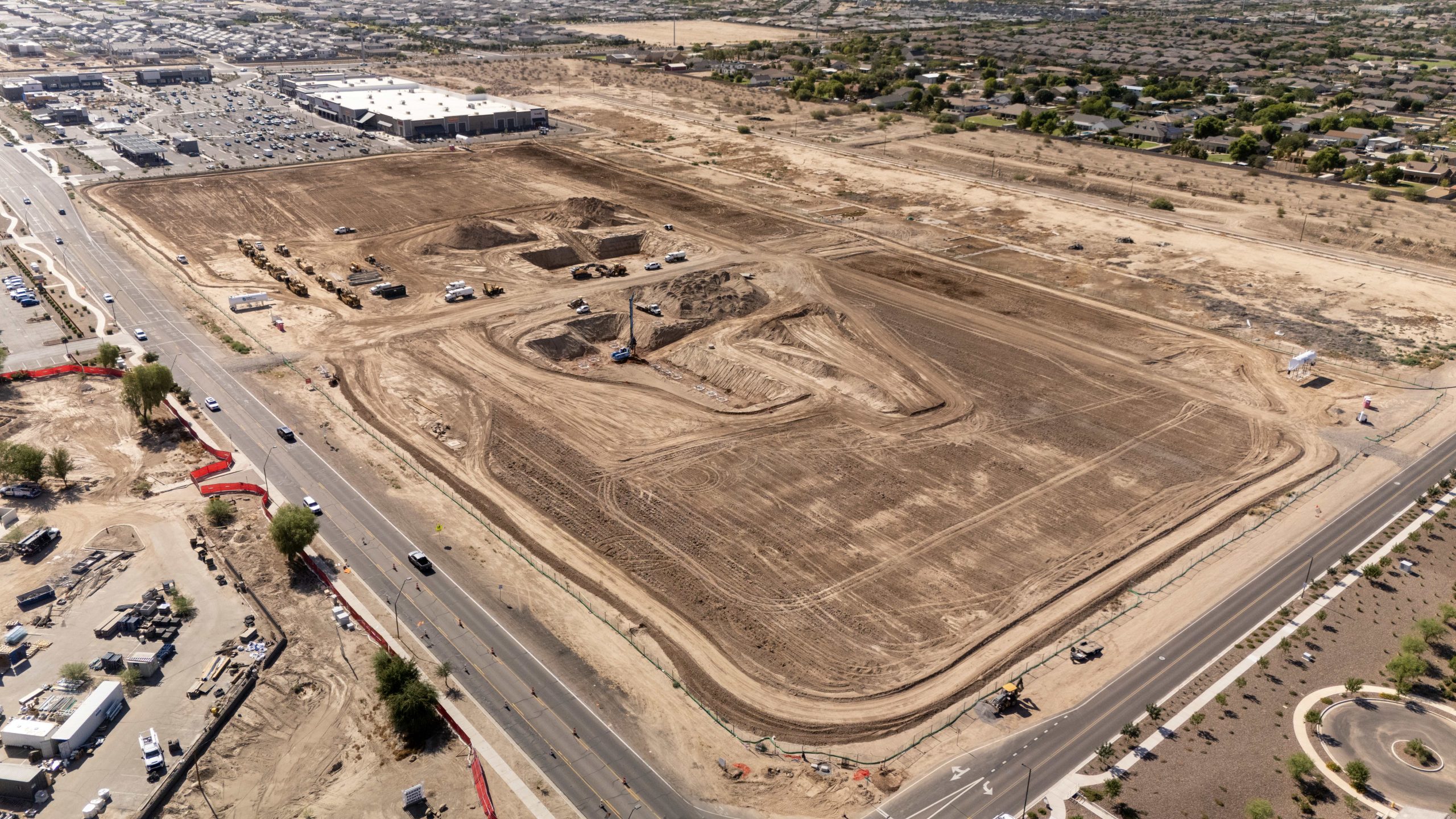
Hudson Station is one of those up-and-coming developments.
This 90-acre, mixed-use community was designed to support the city’s rapid growth, featuring commercial spaces, single-family homes, and townhomes. Nearly 50% of the town’s budget is dedicated to capital infrastructure, including roads, wastewater, and parks.
Challenge
Flood mitigation is a primary stormwater objective in Arizona, especially during monsoon season when intense rainfall can overwhelm surface drainage systems. Solutions used must not only store stormwater but also promote deep infiltration to recharge groundwater and comply with strict regulatory requirements.
Arizona’s unique soil and environmental conditions make stormwater management particularly challenging. A major issue is the caliche layer—a highly impermeable surface layer that prevents rainwater from naturally infiltrating the ground. Combined with roads, parking lots, and other infrastructure, this significantly limits groundwater recharge. Regulations also require stormwater to be managed onsite and engineered to withstand 100-year flood events, meaning that systems must capture, filter, store, and infiltrate water effectively to protect communities today and into the future.
These dynamics create added pressure for developers and landowners to maximize investment while delivering safe and engaging places to live and work. The Hudson Station project was no exception; its stormwater management system needed to meet onsite storage requirements while supporting optimal land use for amenities like turf areas.
Traditional open-bottom systems limited to depths of only seven feet are not ideal in these conditions as water cannot infiltrate effectively through caliche. This limitation increases risk for stakeholders—including developers, municipalities, and contractors—while the burden of failure ultimately falls on the community. Past failures, such as a sinkhole and CMP storm drain collapse at a nearby Chandler shopping center, highlight the consequences of unreliable systems. Combined with tight site layouts and rising costs, these factors demanded a solution that could deliver performance, reduce risk, and maximize usable land.
Hancock Builders, a leading multifamily housing developer and builder, served as the general contractor for Hudson Station. Ownership of stormwater risk typically falls on project stakeholders, but the impact of failure is shared broadly. For Hancock Builders, finding a reliable solution was critical to project success.
Installation added another layer of complexity. Petra, the earthwork contractor responsible for installing the stormwater system, needed a solution that could be integrated seamlessly with grading and drainage plans, installed safely under Arizona’s soil conditions, and completed without introducing additional risk or delays. Petra’s role was essential in ensuring the system performs as designed and supports the overall project timeline.
Solution
To meet these challenges, the team selected MaxCapture™, an integrated system combining StormCapture® and MaxWell® drywells. StormCapture is a robust underground stormwater detention system with a closed-bottom design engineered for Arizona soils.
A key advantage of StormCapture is its solid base slab, which includes openings only directly above the MaxWell drywells. This design ensures that scour at the bottom of the system does not inundate the drywell with sediment, preventing clogging and failure. StormCapture’s closed-bottom design ensures water containment and system integrity in Arizona’s clay-rich soils, unlike open-bottom systems that risk long-term reliability issues. It also offers superior design flexibility, accommodating varied pipe angles and inverts
Beneath StormCapture, MaxWell drywells enable deep infiltration and groundwater recharge without consuming surface space—critical in Arizona’s clay soils for long-term water stewardship. The Maxwell was designed for the project backed by more than 50 years of soil and area topography knowledge. This experience ensures that the drywell is designed and installed at the proper depth and provides reliable water infiltration for decades to come.
The Oldcastle Infrastructure team partnered with the designers early, using GIS data and thousands of drill records to provide precise specifications for the site. Petra also played a vital role in installing the system safely and efficiently, ensuring alignment with the developer’s strong safety culture.
Other dynamics that made this project successful include the partnership between Oldcastle Infrastructure, the engineering group, and Hancock Builders. Oldcastle Infrastructure provided engineering support early in the process, using the online design tool and working with engineers to ensure that the integrated system was quick and easy to incorporate into grading and drainage plans, streamlining approvals and reducing redesign costs.
Impact
The integrated system offers multiple benefits for the project. Total project cost optimization was achieved despite rising material prices, while space efficiency allowed developers to meet municipal requirements for green spaces and amenities. Oldcastle Infrastructure’s in-house manufacturing of cover plates and tie-off points improved safety during installation, reducing fall hazards and supporting Petra’s installation process.
Sustainability was also a major win for Hudson Station. MaxWell supports groundwater recharge, reducing runoff and replenishing aquifers. StormCapture’s modular design minimizes excavation and material waste, while its durability ensures decades of service life, lowering lifecycle emissions. The system is also engineered for 100-year storm events, ensuring resilience against rare, high-intensity rainfall—a critical consideration given recent significant rain events in Arizona.
Outcome
Hudson Station stands as a model for how advanced infrastructure solutions can overcome regulatory compliance, rising costs, and tight site constraints. By leveraging Oldcastle Infrastructure’s StormCapture and MaxWell systems, and partnering with engineers and contactors for expert installation, the project achieved cost efficiency, sustainability, and enhanced livability, all while meeting Queen Creek’s vision for a thriving, resilient community that seamlessly blends with its surroundings.