February 17, 2026
Modernizing an Aging Treatment Plant with High-Performance Grit Removal in Grand Island, Nebraska
Grand Island, Nebraska, is home to more than 50,000 residents and situated along the Platte River and relies on a wastewater treatment system that manages domestic wastewater as well as significant industrial flows, including discharges from a major meat processing facility. The region’s geology features windblown, silty soils that easily enter surface drainage and, eventually, the sewer system. Combined with a high water table and the need for extensive pumping throughout the plant, these conditions create demanding operational challenges.
By the time the City initiated its upgrade program, much of the wastewater infrastructure was nearly 50 years old. Key components were corroded, undersized, and no longer performing reliably. Recognizing the need for a modernized pretreatment system capable of protecting downstream processes, the City launched a comprehensive refurbishment effort to prepare the wastewater treatment plant (WWTP) for decades of growth and regulatory requirements.
Challenges
According to the City’s operations engineer, the plant faced aging equipment, rising flow volumes, and the demands of a growing population. The existing grit basins were inadequate, offering limited redundancy and poor grit removal efficiency. Valves, pumps, and ancillary equipment had deteriorated to the point where replacement was necessary. Additionally, the original grit building lacked odor control, and the Parshall flume and bar screens were undersized and in poor condition.
The combination of silty local soils, industrial inflows, and hydraulic limitations meant that large amounts of grit were reaching downstream processes. This contributed to wear in primary clarifiers, sludge systems, and downstream equipment. To ensure long‑term resilience, the City required a solution that could reliably remove fine grit particles down to 90 microns under both average and peak flow conditions. Redundancy was critical; the plant needed dual treatment trains that could operate independently, both to accommodate peak flows and to ensure continuous operation during maintenance or emergencies.
Solutions
Consulting engineering teams evaluated two primary grit removal technologies: a mechanically induced vortex system and the high‑efficiency HeadCell® / SlurryCup™ / Grit Snail® treatment train, engineered by Hydro International. Both options carried similar capital and installation costs. After visiting a nearby installation in Lincoln, Nebraska, City engineers were particularly impressed by the quality and consistency of grit captured using the HeadCell system.
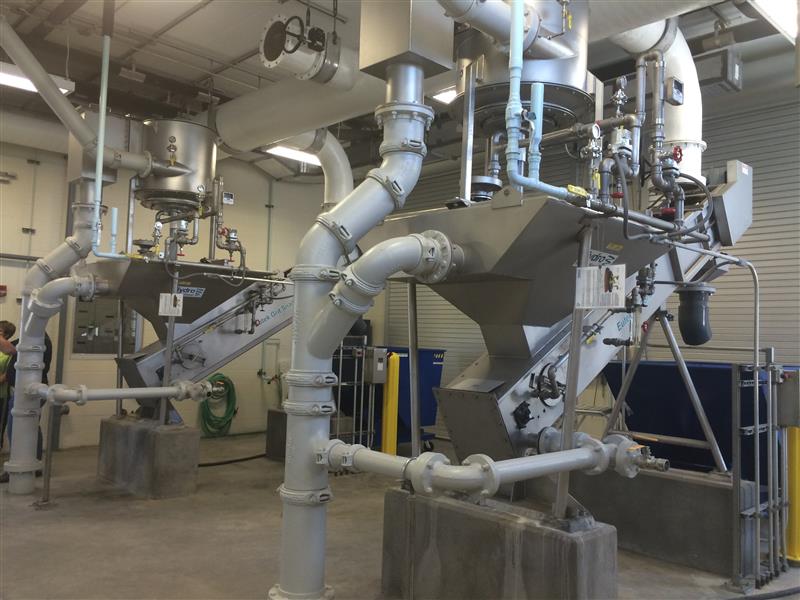
Ultimately, the HeadCell approach was selected due to its superior fine‑grit performance, minimal mechanical complexity, and lower long‑term maintenance needs. The plant was reconfigured to create two parallel, fully redundant treatment trains, each containing a 12‑foot, 10‑tray HeadCell concentrator, dedicated grit pumps, and a complete SlurryCup washing and Grit Snail dewatering system. The layout allowed both trains to function as mirror images, enabling straightforward operation, easier construction, and seamless integration with the plant’s SCADA system through fully automated control panels.
This configuration provided the performance required: removal of 95 percent of particles 90 microns and larger at the design flow of 13 Mgal/d per train, and 95 percent removal of 150‑micron grit at maximum hourly flows of 30 Mgal/d.
Sustainability Impact
The City’s investment in advanced grit management enhances both environmental and operational sustainability. By removing fine grit early, the plant protects clarifiers, aeration systems, and digesters from abrasive damage, reducing the frequency of equipment repair and replacement. Dewatered grit produced by the Grit Snail contains at least 60 percent solids with minimal organics, allowing for efficient disposal and minimizing hauling costs.
Because the HeadCell system includes few mechanical components, energy usage and maintenance needs remain low. The reuse of the original grit building structure also avoided the cost, and environmental impact associated with constructing new concrete basins or expanding plant footprints. The addition of odor‑control accommodations and improved pumping reliability further enhances the plant’s environmental compliance and overall resilience.
Overall Impact
During commissioning, the new grit removal equipment endured an extreme challenge: a year’s worth of accumulated construction debris, sediment, grease, and grit from the replacement of the North Intercept sewer line was pushed through the new treatment trains. The system operated without issue, handling one of the harshest loading conditions it will likely ever encounter.
According to the consulting engineer, the high removal efficiency, minimal mechanical requirements, and long-term maintenance savings made the HeadCell system the superior choice. The system performs far better than previous equipment and is meeting the City’s objectives for redundancy, reliability, and fine-grit removal.
The improved grit system supports the entire plant, protecting critical downstream assets including clarifiers, aeration processes, and digestion facilities. With a 50‑year design life and built‑in ability to handle significant peak flows, the new pretreatment infrastructure positions Grand Island to serve its growing population for decades.
Conclusion
The City of Grand Island’s decision to modernize its headworks using advanced grit removal technologies has transformed the efficiency and resilience of its wastewater treatment operations. Through careful evaluation, forward‑thinking engineering, and a commitment to long‑term sustainability, the City implemented a high‑performance, low‑maintenance solution designed to meet both present and future demands.