February 17, 2026
Stormwater Solutions on Steep Terrain: Elevating the Hillcrest Access Road with Oldcastle Infrastructure
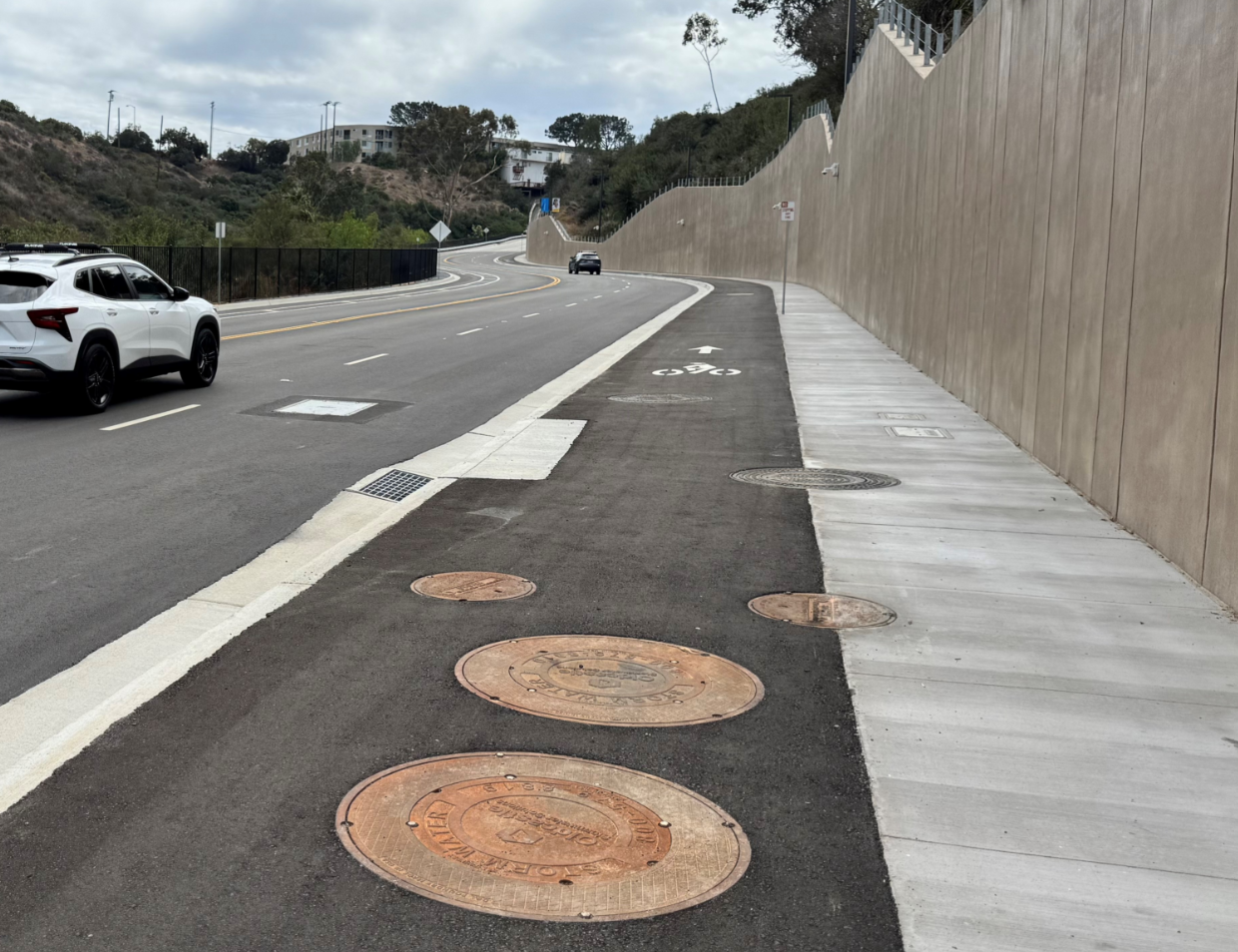
As part of UC San Diego Health’s $3 billion Hillcrest Medical Campus expansion, the organization initiated major improvements to Bachman Place, a 0.6‑mile connector road linking Hillcrest and Mission Valley in San Diego, CA. The road serves dual roles: a public access route and a critical entryway to UC San Diego Health facilities.
Upgrades included widening the roadway to 43 feet, adding dedicated bike lanes, incorporating a 5‑foot pedestrian sidewalk, improving lighting and signage, upgrading utilities, and enhancing travel safety for the steep 9-11% grade corridor.
Given the roadway’s unique ownership status and its importance to both commuters and hospital operations, the improvements required high‑performance, long‑lasting infrastructure solutions.
Challenge
The project team faced significant site constraints due to the roadway running through narrow canyon terrain. Designers had very limited locations available for stormwater treatment and utility placement, forcing the biofiltration system to be installed beneath a pedestrian walkway-an unconventional configuration requiring careful engineering.
Since UC San Diego Health would be solely responsible for roadway maintenance, the organization needed low‑maintenance, robust stormwater BMPs that would minimize lane closures and reduce long‑term operational costs.
Additionally, the City of San Diego rarely approves non‑vegetated proprietary biofiltration systems, creating regulatory hurdles. The steep grade, major utility relocation, environmental review delays, and the need for strong third‑party performance validation further complicated the design and approval process.
Solution
Oldcastle Infrastructure partnered with the engineering team early in the design process to provide specialized stormwater and utility solutions tailored to the project’s space, slope, and ownership challenges. The BioPod™ Biofiltration System was selected for its compact footprint, durable non‑vegetated media option, and reliable third‑party maintenance interval data, making it ideal for installation beneath pedestrian infrastructure while still meeting stringent water quality requirements.
Oldcastle Infrastructure also supplied custom precast components to support utility relocation and structural needs along the steep canyon corridor. Through a comprehensive preconstruction and technical support process, Oldcastle Infrastructure helped model hydraulic performance, address loading concerns, streamline installation sequencing, and provide documentation that enabled the City of San Diego to approve two non‑vegetated proprietary systems-an uncommon achievement. This combination of expertise and product capability delivered a tailored stormwater strategy that met UCSD’s long‑term operational priorities.
Sustainability Impact
The BioPod systems contributed to a more sustainable roadway by delivering reliable stormwater treatment within a constrained environment where traditional vegetated BMPs were not feasible. Their low‑maintenance design reduces long‑term resource consumption and minimizes disruption to vehicle flow, lowering the environmental impact associated with frequent maintenance closures.
The precast components provided by Oldcastle Infrastructure supported efficient installation, reduced onsite construction emissions, and created durable, long‑life infrastructure aligned with UCSD’s goals for future‑ready campus development. By enabling effective pollutant removal on a steep, highly trafficked corridor, Oldcastle Infrastructure’s sustainable solutions helped enhance environmental protection for the surrounding canyon ecosystem.
Overall Impact
Completed in June 2025, the project delivered a safer, wider, and more efficient roadway equipped to support future medical campus growth. The enhancements improved mobility for drivers, cyclists, and pedestrians while significantly reducing commute times-estimated by UCSD to save drivers up to 30 minutes.
Oldcastle Infrastructure’s stormwater and utility solutions played a critical role in resolving space, maintenance, and regulatory challenges, reducing long‑term ownership costs, and ensuring the roadway performs reliably under demanding site conditions. The approval and successful deployment of non‑vegetated proprietary systems also set a precedent for innovative stormwater management in dense, topographically complex areas.
Conclusion
The UC San Diego Hillcrest North Access Road project demonstrates how early collaboration and engineered precast solutions can overcome significant geographic and regulatory constraints. Oldcastle Infrastructure’s BioPod solution and precast components enabled the project team to deliver a high-performing, low‑maintenance, and environmentally responsible roadway that supports both public circulation and hospital operations.
This project highlights the importance of selecting adaptable, high‑performance infrastructure solutions, especially when working within narrow, highly regulated, and environmentally sensitive corridors. Oldcastle Infrastructure’s involvement ensured a successful outcome and reinforced its role as a trusted partner in complex, sustainability‑driven infrastructure projects.