February 18, 2026
Transforming Headworks Efficiency in Council Bluffs Through Advanced Grit Removal Technology
Council Bluffs, Iowa, a community of 60,000 located along the east bank of the Missouri River, has long balanced a strong industrial presence with modern commercial growth.
Global food processors, agricultural manufacturers, and large-scale operations including ConAgra, Tyson Foods, American Games and Barton Solvents anchor the region’s economy. In recent decades, casinos and large data centers, such as Google’s two local data centers, have added further diversity.
Wastewater for the entire community has been treated at the Council Bluffs Water Pollution Control Plant since 1974. Much of the original infrastructure, including its primary clarifiers, pretreatment facilities, and two‑stage rock media trickling filters. remains in service. In 1997, an activated sludge basin was added, increasing treatment flexibility and capacity. Today, the facility manages average flows of 7 Mgal/d, with peak flows up to 30 Mgal/d.
Initially, the headworks relied on two one‑inch bar screens and aerated grit basins. Though durable, this legacy system struggled to remove the region’s fine loess sands, leading to operational challenges downstream.
Challenges
Over time, the plant’s aerated grit basins were no longer capable of achieving adequate grit removal. Fine loess sand, naturally abundant in the surrounding terrain, passed through the original system and accumulated in aeration basins, digesters, and mechanical equipment.
According to the Plant Supervisor, the consequences were substantial. Excess grit was causing premature wear on the sludge dewatering centrifuges, generating recurrent maintenance requirements and costly repairs. Digesters routinely require cleaning, revealing up to three feet of accumulated grit.
The team determined that modernizing grit removal was essential to protect downstream processes, reduce maintenance costs, and extend equipment lifespan.
Solutions
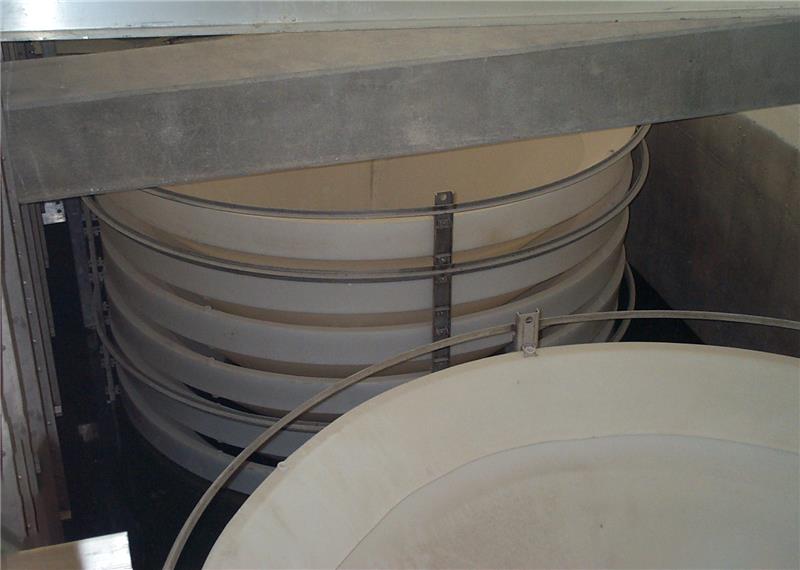
After evaluating multiple alternatives, the City selected an advanced HeadCell® stacked‑tray grit separation system, supported by SlurryCup™ washing technology and Grit Snail® dewatering, solutions engineered by Hydro International.
A key advantage was the ability to retrofit the new system directly into the existing aerated grit basin, avoiding the need for costly concrete replacement, additional pumping infrastructure, or expanded influent channels.
Engineering teams successfully integrated:
- Four 12‑foot, seven‑tray HeadCell units
- Two 32‑inch SlurryCup grit‑washing units
- One Grit Snail dewatering escalator
This configuration delivers 95% removal of grit 75 microns and larger, with very low headloss and no moving parts in the HeadCell itself. During normal flow periods, operators need only run half of the system, reducing energy and maintenance requirements.
The SlurryCup provides high‑efficiency washing and classification, removing fine grit, sugar sand, snail shells, and other dense solids. The Grit Snail completes the process by gently dewatering fine grit without re‑suspending material.
Sustainability Impact
The retrofit has produced long‑term sustainability benefits for the City. With vastly reduced grit carryover:
- Digesters remain cleaner, avoiding the need for frequent shutdowns and landfilling of accumulated solids.
- Centrifuge wear has dramatically decreased, reducing the frequency of major repairs from several times per year to a single repair over many years.
- Lower energy demand and minimized need for new pumping infrastructure contribute to reduced operating footprint.
By reusing existing structures rather than constructing new basins, Council Bluffs avoided the cost, and environmental impact associated with large‑scale concrete work or new pumping stations.
Overall Impact
Plant staff report a substantial and measurable improvement in performance. Grit accumulation in digesters has virtually disappeared. Mechanical equipment life has improved, lowering annual maintenance expenditures by tens of thousands of dollars. Operators appreciate the simplicity of the system, the minimal moving parts, and the consistency of grit capture even under variable flow conditions.
The City’s consulting engineer noted that the HeadCell system’s compact footprint, innovative design, and cost savings made it the most advantageous choice among all evaluated alternatives.
As summarized by the Plant Supervisor, they have seen a number of paybacks. There’s less wear on the centrifuge; they weren’t taking digesters offline to clean them, and they avoided building and maintaining another pump station. This system has done everything we wanted at a very reasonable cost.
Conclusion
The Council Bluffs Water Pollution Control Plant’s investment in advanced grit removal technology has delivered significant operational, financial, and environmental benefits. By leveraging a retrofit‑friendly design and high‑efficiency grit separation, the City modernized a critical part of its treatment process without major structural modifications.
The project resulted in a more resilient, lower‑maintenance, and sustainable headworks system that protects downstream infrastructure and will support the community’s growth for decades to come.